

Got a lemon? Contact Johnson Attorneys Group at 1-800-558-1087 for a free consultation.
California Lemon Law Attorney James Johnson Examines Owner Reports of Brake Failures, Electrical Problems, Malfunctioning Safety Systems and More
The 2025 Toyota Camry Hybrid has attracted significant attention from vehicle owners reporting potential safety and reliability problems. According to NHTSA data updated in October 2026, the vehicle has been associated with 173 owner complaints, six safety recalls, and 65 manufacturer communications. The complaints describe a range of concerns, from malfunctioning dashboard displays and backup cameras to braking problems, defective headlights and airbags that reportedly failed to deploy during a serious crash. Source: NHTSA complaint and recall data.
For drivers who purchased or leased a 2025 Toyota Camry Hybrid, these reports raise important questions about vehicle safety, warranty repairs, and potential remedies under California’s Lemon Law.
Attorney James Johnson, a California lemon law attorney, helps consumers understand their rights when a vehicle develops persistent defects that the manufacturer or dealership cannot adequately repair.
Six Recalls Raise Concerns About Vehicle Safety
 The 2025 Toyota Camry Hybrid’s recall history includes issues involving its electrical system, hybrid propulsion system, seat belts, rear visibility, and other equipment. One particularly concerning recall, announced in December 2025, involved certain 2025–2026 Camry Hybrid vehicles and 2026 Corolla Cross Hybrid vehicles.
According to the recall report, a bolt inside the inverter may not have been properly tightened, potentially causing an incomplete electrical connection. The resulting problem could lead to a loss of driving power and increase the risk of a crash. A loose bolt could also cause an electrical short and fire risk. The recall potentially affected approximately 55,405 vehicles across the listed models. Source: NHTSA Recall 25V869.
Another recall addressed a software problem that could cause the rearview camera image to freeze or disappear when the driver shifts into reverse. A malfunctioning backup camera can compromise rear visibility and create a risk for pedestrians, cyclists and other vehicles.
The instrument cluster has also been the subject of a recall involving certain 2025–2026 Camry Hybrid vehicles. The display may fail during startup, potentially disabling important functions, including turn signals, hazard lights, seat belt warnings and the smart key reminder.
These official recalls are separate from individual owner complaints, which may describe additional problems that have not been confirmed as manufacturing defects.
Owners Report Dashboard Failures and Electrical Malfunctions
Electrical and electronic problems appear repeatedly in owner reports involving the 2025 Toyota Camry Hybrid.
Some drivers describe dashboard displays going blank, warning messages appearing unexpectedly and vehicle safety systems becoming unavailable. Reported concerns include failures involving collision warnings, lane-change alerts, power steering warnings and other driver-assistance functions.
One owner from Vista, California, reported a particularly alarming incident involving an alleged electronic braking and computer-network failure. According to the complaint, the brake pedal became unusually soft and the vehicle failed to slow as expected during a low-speed stop, resulting in a collision. The owner also reported multiple system warnings following the impact, including airbag, headlight and general system malfunctions. The complaint stated that a child was injured and evaluated at an emergency room.
These allegations have not necessarily been independently verified. However, reports involving braking performance and multiple safety-system failures deserve serious attention because of their potential consequences.
Airbags Allegedly Failed to Deploy in a High-Speed Crash
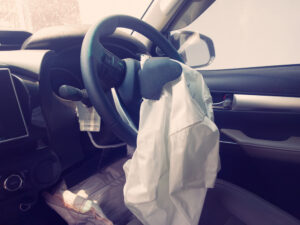 One NHTSA complaint described a devastating freeway collision involving a Las Vegas driver whose Camry Hybrid was reportedly struck from behind by a van traveling at approximately 65 mph or faster. The impact allegedly caused the vehicle to spin into oncoming traffic, where it was struck again.
The driver reported that the airbags did not deploy despite the severity of the collision. The complaint also described a concussion, neck and back injuries, shoulder pain and other physical problems, along with dizziness and periods of unconsciousness.
An airbag’s failure to deploy does not, by itself, establish that the system was defective; deployment depends on factors such as the direction and severity of the impact and the vehicle’s sensing criteria. Nevertheless, an owner who believes an airbag malfunctioned in a serious crash may wish to preserve the vehicle, obtain the crash and repair records, and seek a qualified investigation.
Headlight Delays Could Leave Drivers in the Dark
A New Jersey owner reported that the vehicle’s automatic headlights took approximately 16 seconds to activate when entering a dark environment, such as a tunnel or underpass.
According to the complaint, the dashboard illumination dimmed immediately, suggesting the system had detected the change in ambient lighting, but the headlights remained off for several more seconds.
At highway speeds, that delay could mean traveling a substantial distance without headlights. The owner reported taking the vehicle to the dealership twice without a resolution and contacting Toyota’s corporate customer service without obtaining a satisfactory technical fix.
If an automatic lighting system does not operate as intended, the problem could reduce a driver’s ability to see the road and make the vehicle less visible to other motorists.
Windshield Wipers, Front Bumper Clips and Other Reported Defects

Not every complaint involves a dramatic safety-system failure. Some owners have described recurring problems that affect everyday driving, visibility or confidence in the vehicle.
Examples include:
- Windshield wipers that streak: Several owners reportedly complained that replacement wiper blades continued to streak the driver’s field of vision. One owner said Toyota characterized the condition as a common feature of the model.
- Front bumper attachment problems: Owners described plastic clips or brackets beneath the headlights repeatedly coming loose, leaving gaps between the bumper and the vehicle body. One complaint stated that a dealership acknowledged the problem but could offer only a temporary fix.
- Power steering warnings: A driver reported receiving a warning that power steering assistance was reduced, alongside failures involving collision-prevention and lane-change warning systems.
- Unexpected acceleration and electronic anomalies: Another owner alleged that the vehicle accelerated unexpectedly while adaptive cruise control was engaged and described unusual infotainment connections and warning messages. The cause was reportedly undetermined.
These are allegations submitted by vehicle owners, not findings that every affected vehicle has the same defect. Still, recurring problems that remain unresolved after dealership visits can become a significant source of frustration. If that is the case, it may warrant further investigation.
What Can Toyota Camry Hybrid Owners Do Under California’s Lemon Law?
California’s Lemon Law, part of the Song-Beverly Consumer Warranty Act, may provide legal remedies. Specifically, when a vehicle has qualifying defects covered by the manufacturer’s warranty and the manufacturer cannot repair them after a reasonable number of attempts.
Depending on the facts, a qualifying consumer may be entitled to a vehicle repurchase or replacement.
Several factors may be relevant when evaluating a potential lemon law claim:
- The nature of the defect: Problems affecting braking, steering, airbags, electrical systems or other essential functions may raise substantial safety concerns.
- Repair history: Repeated unsuccessful attempts to repair the same problem may help establish that the manufacturer has not fulfilled its warranty obligations.
- Time out of service: Extended periods in the repair shop may be relevant to eligibility.
- Documentation: Repair orders, warranty records, invoices, written communications and a detailed timeline of symptoms can help establish the history of the problem.
There is no single number of repair attempts that automatically determines every claim. The applicable legal standards depend on the circumstances, and a recall alone does not automatically make a vehicle a lemon. Conversely, a vehicle may potentially qualify even when the specific problem has not resulted in a recall.
Consumers can check for recalls affecting their individual vehicles using the official NHTSA recall lookup.
Contact California Lemon Law Attorney James Johnson

Attorney James Johnson, California lemon law consultation 1-800-558-1087
If your 2025 Toyota Camry Hybrid has experienced recurring electrical problems, brake malfunctions, dashboard failures, defective safety systems or other warranty-related defects, you do not have to navigate the situation alone.
Attorney James Johnson helps California consumers evaluate potential lemon law claims and understand their options when manufacturers fail to resolve vehicle problems.
A free consultation can help you determine whether your vehicle’s repair history and circumstances may support a claim under California law.
Call Attorney James Johnson at 1-800-558-1087 for a free consultation about your potential California lemon law case.
Learn more at California Lemon Attorneys.
This article is for informational purposes only and is not legal advice. NHTSA complaints reflect reports submitted by owners and do not independently establish that a defect exists. Lemon law eligibility depends on the specific facts and applicable law.

- 2025 Toyota Camry Hybrid Problems: 173 NHTSA Complaints, Six Recalls, Safety Concerns - October 28, 2026
- Toyota Grand Highlander Lemon Law Alert: NHTSA Investigates Heat Exchanger Problems - October 23, 2026
- Ford Recall for Piston Dome Defect in 2026 Bronco, Explorer, Mustang, Ranger - September 3, 2026